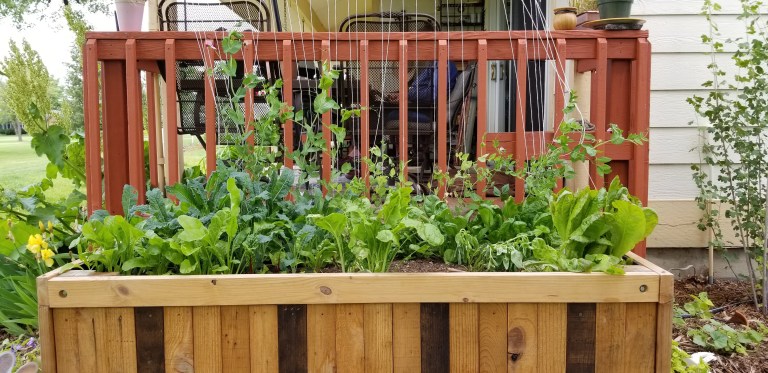
This fall I made a raised bed made from recycled materials. Pallet wood was found on craigslist, I picked it up from behind a Subway in Loveland and broke it down into planks and 2x4s in the parking lot with a crow bar and hammer. I found more 2x4s and other useful materials on craigslist posted for free and picked them up from local design/build operations and, with permission, from dumpsters of local businesses.
Stains were acquired from the hazardous waste exchange at the Fort Collins-Loveland landfill. If you need paints and stains for a personal project check with your local waste management facility, you can deposit and exchange most household craft supplies, paints and chemicals there for free. The inside of the raised bed is lined with plastic found on the side of the highway. Think industrial sheets of plastic, left over from industrial agriculture processes, caught in bard wire fences. The time spent gathering materials and building the raised bed provided time for reflection on the processes, wants and needs of humans, challenging problems to solve, and ways to think about them.
Saw dust and measurement, bolts and wrench, music on the laptop, digital beats and acoustic guitars, design and motivation become something at the intersection of atheistic and functionality. From the trash, the reality of our wastefulness and the process of our consumption makes me look at what it is that we create and how. Its taken away but where does it go? All the plastic, all the wood, past its capital function, price no longer a fixed, viable and placed aside as waste. From waste materials gathered with a bit of searching and effort, free dirt and helpful folks, this garden box is now brimming with spinach greens, lettuce, chard and beans.
I designed and built the box for my families property. A modest duplex with landscaping (I designed and implemented a landscaping of edible Colorado native currants and raspberries) but not a lot of land for planting. Housing regulations and a lack of a sizable piece of land for a garden has made growing food here difficult, but this project has allowed us to bring personal food production to this suburban duplex. I designed and built, Madre planted and we gathered materials together. Bounty is, and for that I celebrate, but from where does all our bounty come from? What of all our waste? What processes go into making our material world? Which are harmful and wasteful?
Natures processes within an ecosystem are never incorrect, it is the processes and motivations of humans, the demanding rate of american consumerism, our inherited disposable culture, and our collective plastic and oil addictions that disrupt the natural systems cycles and processes.
Business is driven by the demand for goods and by the financial bottom line, but the bottom line in reality is that much of what is created and distributed is expensive to the environment and could jeopardize a bountiful future for generations to come. The production and distribution of goods using energy intensive shipping and production methods, such as gas, oil, Styrofoam and single use plastics is a standard that simply can not be maintained in the long run. Can our systems of managing and distributing food and material goods be made less harmful and more sustainable or even regenerative?
How can we produce less waste and how can we better use the viable waste we have created, before it enters the landfill?
Observation of natural cycles and the processes of natural systems helped to guide this project. I have been walking two times a day for the past year out on the single track east of the Powertrail in South Fort Collins and recently applied permaculture principles and design to set up a few wild garden plots . Observations of the environment year round and over time lead to a series of understanding of wild edibles, the natural processes of the area, such as where water collects, where to find naturally rich soil due to composting, and knowing the indicators of living soil, the presence of worms and mycelium (fungus) growth.


Humans are the greatest natural force effecting the processes of the natural environment, mainly due to the creation of materials, such as plastic, which are not reabsorbed into the earth’s natural processes of composition, decomposition and from energy processes, burning of coal and oil, that create waste and emit pollution.
In order to build and design a better world, we must look at how nature operates and begin to think more clearly about how we can produce the things we need, how to design human systems without choking natural systems and without threatening other species, habitats and our climate.
Seeing the beautiful green lettuces and chard growing from something I designed, and then built from waste, speaks to me of a cycle, a beautiful relationship between humans and nature that is in need of mending.
All parts of this design would otherwise have been waste, trash on the side of the road and trees in a dumpster, leftover wood from pallets used in shipping. The greater understanding revealed through this creative process is that people are constantly in need. People need food and material goods, but our propensity for excess and expectation of convenience has created unsustainable and destructive systems.
Our trajectory of consumption and the systems we have created are aggressive towards nature and in the long run to ourselves. People need and will always be in need, but how we go about getting what we need is impactful. This creative act of using reclaimed materials to create a raised bed, is a demonstration of how design and the sourcing of materials can turn waste into structure and structure into a maintainable and natural cycle of food production for people to enjoy. Awareness of the processes we engage in, design, function, observation of the earth system, and reclamation were a large part of this process.
The way we live, the food we eat and our mental health all tie into what we do, and how we do it. Human systems and the earth system are in argument, but we can begin to settle this dispute by examining the natural world, how it works, and how we can design for it. Far from a negative view, a healthy skepticism of inherited systems and harmful processes is more of what we need as we move forward. In completing this process, I proclaim that people should get what they need while producing less waste and excess. May we continue to design a world that is true to the processes of nature, bountiful for humankind and regenerative to our shared environment.


Happy spring and enjoy the garden!
Discover more from I_Nonself Creative - Media / Design / Art / Music Archive
Subscribe to get the latest posts sent to your email.
