Over the past year I collected all the seeds from the vegetables we had grown the previous year as well as what we had bought at the local farmers market and from the store. Eshes market in Loveland, CO is a place that often buy my groceries. Year round they have inexpensive produce, and they resell bulk product from other organic food stores, products that are close to expiration or from local and alternative distributes. I removed the seeds from squash, tomatoes, peppers and beans placing them on dishes and scraps of paper bags to dry. I designated a shelf on these rolling racks in the kitchen and put little bowls out on the counter, so when I was cooking I would remember to save the seeds. I just started doing it every time I cook and I ended up with a ton of seeds. I stored some in a book of cards, plastic dividers for baseball cards. You know those coupons that you get in the mail, the packet of loose leaf coupons, the ones that I only ever use the liquors store, pet food, and Ironworks recycling center coupons that pay you a few bucks for your aluminium cans. I folded those up as little seed envelopes and placed them in the plastic card holders. A mini library of seeds.


I take walks with Carson, our Australian Shepard Border Collie mix, Madre was fostering him and I said he should stay. We walk out along the golf course, past the power trail, to the dirt trail on the other side of the rail road tracks. I’ve been walking out there enough to notice the plants and animal life. The changes and patterns as the seasons progress. I’ve found wild plums, asparagus, dock, wild ground cherries kinda like a mini tomotilla.
I also started to notice the soil, when it looked rich and fertile, full of mycellium and worms. A healthy, musky dankness, moist and full of decomposed and decomposing organic matter, leaves and grasses. I spent time sitting in the field, observing and meditating. I developed a feeling for the area, started spreading seeds and taking photographs of the beauty I found through out the year.
When spring came, I began to notice that people had been pilling up there grass clippings in a ditch where the golf course and the open field meet. The clippings had been decomposing for some time and the soil was rich, full of all the right stuff for soil to grow hearty plants without being amended. The ditch would naturally catch water from the rain. It was overgrown and was not used for irrigation. As far as I could tell it was a product of the boundary between the manicured golf course and the wild grass field, something of a man made ecotone, a zone between two ecosystems. I also spotted an area from the bridge on the power trail, an empty patch where the farmer who owned the irrigation ditch had piled up sticks which had decayed into a mixture of fine soil, bark, and woody bits.
I decided to do an experiment with some of the seeds I had saved. I had built a raised bed planter out of recycled materials, and we had put some seeds in there. We found free fill dirt on craigslist. Filled the raised bed and filled some large round planters with tomatoes, squash and herbs. With a ton of seeds still and after observing some prime patches of soil and compost out in the field that would grow some squash and sunflowers without a whole lot of effort, I planted some squash and pumpkin, all different varieties, some sunflowers, and some plants I had rescued from the surplus of plants being taken to the dumpster at the Gulley Greenhouse. These soil conditions, the location and the geological features, the bridge plots proximity to water and the ditch plots ability to retain water with the U shape of the ditch made for a prime permaculture experiment.
I would plant the ditch plot and let nature do its things, I would let the rain water the plot and hope that the ditch shape would capture enough water for the sunflower, squash, corn, orach, and peppers. I would walk by every other day or so, take some pictures and see how the plants were doing.


The Ditch plot
The ditch plot had extremely rich soil, full of worms and mycorrhiza. The term mycorrhiza refers to the role of the fungus in the plant’s rhizosphere, its root system. The bridge plot had access the irrigation water. I ended up meeting one of the farmers who was responsible for the ditch, he approved of what I had done and we talked as I watered the plants, lowering a string with a bucket into the water and then drenching the plants.
All season, aside from a major hail storm with golf ball sized hail, the plants on both plots were happy and vibrant. The sunflowers grew fast and opened there sunburst yellow flowers, the squash crept and sprawled, one healthy organism, there green fluted leaves to the sky. When I planted them, I had not labeled the seeds when I placed them on the dishes and paper bags, so I did not know exactly what kinds of squashes we would end up with.
The corn that I planted grew tall but they never produced an ear of corn, the peppers were covered up by more lawn clippings (hazards of a wild plot in a shared area). The squash and sunflowers became the star of the season.
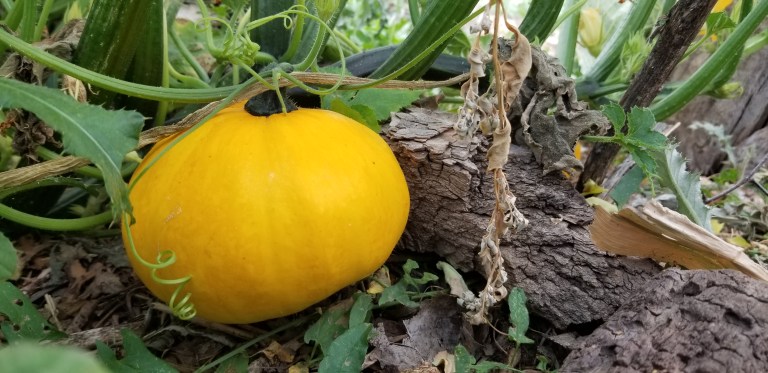
The ditch plot yielded an amazing growth for not being watered daily like the bridge plot. The plants in the ditch plot were smaller, but yielded more squash in ratio to the size of the plant. The plants I watered daily grew huge and produced a lot of flowers, and squash as well, but it seemed that all the watering was going into growing the plant larger, and producing less squash in ratio to its size. I harvested a few early on and then harvested twelve squash and a few pumpkins.
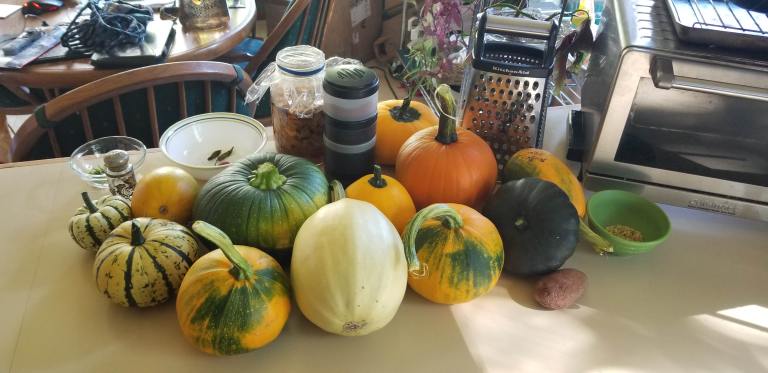
I don’t know all the names of them, but they look amazing, full and bountiful. If you know the names of these squash please let me know or comment below.
Through this season I’ve been learning about how natures process work together to grow an ecosystem, teaming with life. All the pollinators came out to the plants I had grown, honey bees, bumble bees, some black flying insects with bright yellow pollen on there hind legs. I sat and meditated at the Bridge plot and saw all the signs of a healthy system, lots of biodiversity, no pests visibly destroying the plants. In the squash flowers I found squash bugs, small elongated beetles with black and yellow stripping on their back. The internet said they were a pest but the plants seemed relatively undisturbed by there presence.


The Bridge Plot – That squash is a happy organism
I harvested lots of squash flowers. They are good sauteed, with oil and some salt. Tall sunflowers grew from the under-story of the squash. Beans would grow well with the sunflowers if they were started earlier. The broad-leaf of the squash creates a lot of shade on the under story. What else could grow in this mini ecosystem, under the squash or above the sunflowers?
There is a truth in taking a walk with the dog to water the plants. Very much a human activity, centuries old, a daily ritual, time for contemplation, reflection and nature, helping to bring our plants and vegetables to life.


Sunflowers and Harvest

Discover more from I_Nonself Creative - Media / Design / Art / Music Archive
Subscribe to get the latest posts sent to your email.
